
The Terminal Takeover: A Florida Parent’s Guide to Stress-Free Flying
The Terminal Takeover: A Florida Parent’s Guide to Stress-Free Flying
March 24, 2026
1. Know Your Regional “Safe Zones”
Airports in our region have made incredible strides in neurodiversity-affirming travel. Depending on where you live, your “home base” airport offers different perks:
- Tampa International (TPA): Consistently ranked as one of the most accessible airports. TPA offers the Hidden Disabilities Sunflower Lanyard (available at the Information Desk) to signal to staff that your family may need extra time or a quieter approach.
- Orlando International (MCO): For our Clermont families, Terminal C is a game-changer. It features “Annie’s Space,” a dedicated sensory room designed for de-escalation before or after a flight.
- Sarasota-Bradenton (SRQ): The “hidden gem” for our Sarasota families. Because it is smaller, the walk from the curb to the gate is much shorter, reducing “transition fatigue.”
- St. Pete-Clearwater (PIE): A favorite for Pinellas families. The smaller terminal means fewer crowds and a less overwhelming “echo” than the larger hubs.
2. Strategies for the Tarmac
Don’t just hope for a good flight—plan for it using these clinical tools:
- Successive Approximations (The “Dry Run”): If your child has never seen a plane, do a “practice visit.”
- Tampa/Land O’ Lakes: Visit the TPA Cell Phone Lot to watch planes land for free.
- Pinellas: Watch takeoffs from Albert Whitted Park in St. Pete.
- The “First-Then” Board: Keep it simple and visual. “First security, then iPad.” “First buckle up, then gummy bears.”
- Functional Communication: Ensure your child has a “Break” card or a specific gesture to tell you when they are reaching their sensory limit before a meltdown occurs.
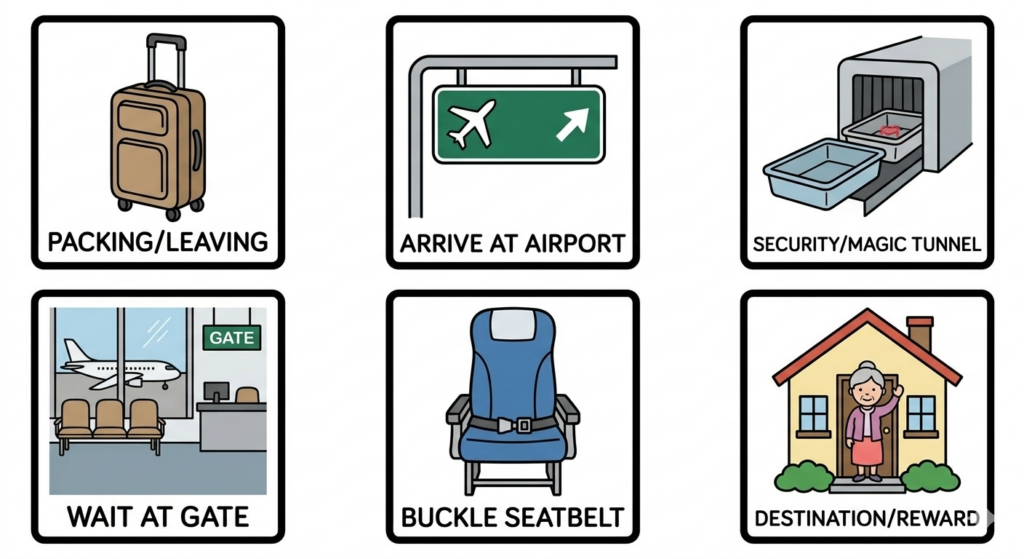
3. Your Visual Schedule: A Predictable Roadmap
Predictability is the ultimate de-escalator. Use these 6 steps to create a visual schedule for your child:
- Suitcase: Packing and leaving the house.
- Airport Sign: Arriving at the terminal.
- The Magic Tunnel: Putting bags in the security X-ray bins.
- The Gate: Waiting for the “Big Plane.”
- The Airplane Seat: Buckling in for takeoff.
- The Reward: Arriving at your destination (Grandma’s, Disney, or the Beach!).
4. The 2026 “Secret Weapon”: TSA Cares
This is a free service every ABA family should use. When you call TSA Cares (1-855-787-2227) at least 72 hours before your flight, you can request a Passenger Support Specialist. This person can meet you at the curb and escort you through a private or quieter security lane.
Use this script when you call:
“Hi, I am traveling with my child who has autism. We are flying out of [TPA/MCO/SRQ/PIE] on [Date]. We would like to request a Passenger Support Specialist to assist us through security to minimize sensory triggers. Does my child need to remove their shoes, or can we request a modified screening?”
🎒 THE SENSORY GO-BAG CHECKLIST
Before you head to the gate, ensure your carry-on is “ABA Ready”:
- [ ] Noise-Canceling Headphones: Essential for the engine roar.
- [ ] Chewy Jewelry or Fidgets: To help with ear pressure and anxiety.
- [ ] Fully Charged Device + Portable Power Bank: Tech is a valid coping tool!
- [ ] High-Preference Snacks: Avoid “hangry” meltdowns by bringing their favorites.
HOW WE HELP YOU WIN
At ABA Solutions, our ABAs can actually help you practice these transitions during our “Community Outing” sessions. Whether it’s practicing for a flight or just a trip to the local park, we help your child generalize their skills to the real world.