
Your Updated Guide to the BACB’s 2026–2027 Certification Changes (RBT, BCaBA & BCBA)
Your Updated Guide to the BACB’s 2026–2027 Certification Changes (RBT, BCaBA & BCBA)
September 3, 2026
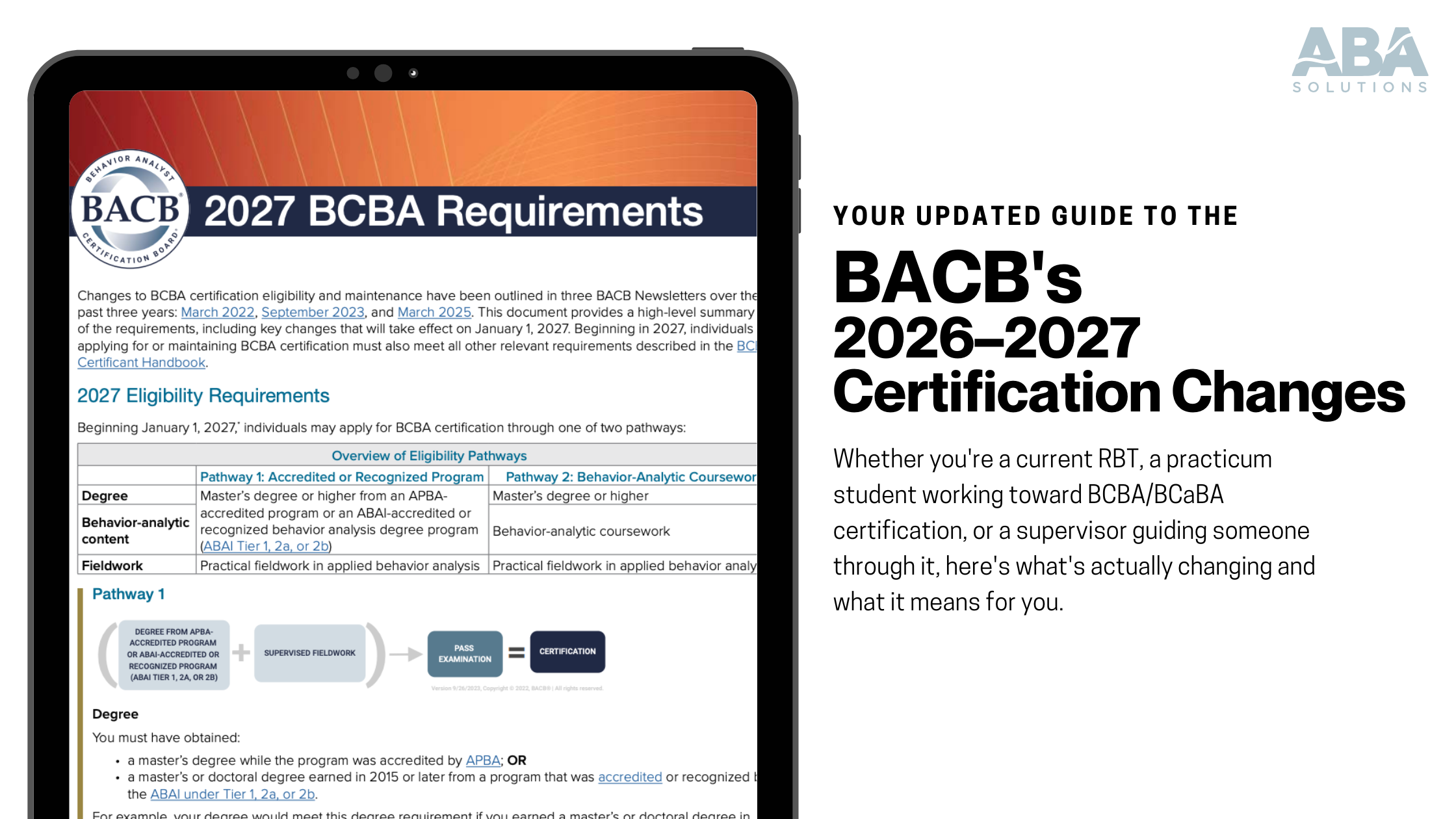
If you work in ABA — or you’re training to — the certification landscape is shifting. The Behavior Analyst Certification Board (BACB) has rolled out new requirements for RBTs that took effect January 1, 2026, and bigger changes are coming for BCBAs and BCaBAs on January 1, 2027.
Whether you’re a current RBT, a practicum student working toward BCBA/BCaBA certification, or a supervisor guiding someone through it, here’s what’s actually changing and what it means for you.
RBT Changes — Already in Effect (January 1, 2026)
If you’re an RBT or pursuing RBT certification, these changes already apply to you.
What changed:
- Training now follows the 3rd Edition RBT Test Content Outline and updated 2026 curriculum. If your old training certificate expired without the new approval language, there’s no bridge course — you’ll need to retrain.
- Recertification shifted from an annual cycle to a 2-year cycle. Instead of an assessment every year, RBTs now earn 12 PDUs (Professional Development Units) per 2-year cycle. PDUs come from in-service training, ACE Provider events, or university coursework.
- Supervision requirements are unchanged — still 5% of monthly service hours, including two face-to-face contacts.
Quick FAQ:
- Do I need 12 PDUs for my 2026 recertification? No — 2026 recertifications still use the old competency assessment. The 12-PDU clock starts after that, with your first PDU-based renewal due in 2028.
- Does supervision count as PDUs? No, they’re tracked separately.
- New RBT certified after Jan 1, 2026? Your 2-year PDU cycle starts immediately, no transition period.
Do: start earning PDUs early rather than at the deadline, keep documentation of every completed PDU, and confirm asynchronous PDU courses include the required knowledge-check questions (a July 2026 requirement).
Don’t: assume supervision hours count toward PDUs, or assume a lapsed training can be picked back up without redoing the full 40 hours.
BCaBA & BCBA Changes — Coming January 1, 2027
These changes are further out, but if you’re currently accruing fieldwork hours, the timeline matters now — not in 2027.
Pathways 3 and 4 Are Being Discontinued
Starting January 1, 2027, certification Pathways 3 and 4 (routes that didn’t require a formal degree in behavior analysis) will no longer be available. Going forward, applicants will need to meet the updated Pathway 2 coursework-and-attestation requirements, or pursue an accredited program pathway. If you’re currently on Pathway 3 or 4, this is worth a direct conversation with your supervisor about your application timeline.
Fieldwork Hour Structure
Total hour requirements aren’t changing — 2,000 hours for supervised fieldwork, 1,500 for concentrated. What’s changing is the structure:
- Monthly hour cap rises from 130 to 160 hours.
- Concentrated fieldwork supervision drops from 10% to 7.5% (hours already earned at 10% still count — nothing is wasted).
- Observation tracking shifts from counting monthly visits to logging total observation minutes: 60 minutes/month for supervised fieldwork, 90 minutes/month for concentrated.
Coursework Restructuring (Pathway 2)
- Basic Principles of Behavior and Theory & Philosophy become separate, standalone courses.
- Behavior Assessment & Intervention content splits across two courses totaling 90 hours.
- Organizational Behavior Management content increases from 30 to 45 hours.
- Ethics becomes its own standalone course.
- Total coursework hours stay at 315 — this is a restructuring, not additional workload.
CEU Changes for Supervisors
BCBAs who supervise RBTs, BCaBAs, or trainees will need 4 supervision CEUs per 2-year cycle, up from 3, starting with cycles beginning on or after January 1, 2027. Total CEU requirements (32 for BCBAs, 20 for BCaBAs) and ethics CEUs (4 for both) aren’t changing.
The Part That Matters Most Right Now
If your BCBA/BCaBA application timeline is anywhere close to January 1, 2027 — or you’re just not sure yet — the BACB’s own guidance recommends tracking your fieldwork against both the 2022 and 2027 requirements simultaneously. Specifically:
- Start logging observation duration in minutes, not just monthly check-ins, even if you expect to apply before 2027.
- Keep both sets of monthly verification forms up to date if your timeline isn’t locked in.
- Talk to your supervisor now about which standard your hours are being tracked against.
Retrofitting months of past fieldwork data to a new standard is much harder than tracking dual documentation as you go.
Our Approach at ABA Solutions
We’re already adjusting how we support our RBTs, practicum students, and supervisees ahead of these changes:
- RBTs recertifying in 2026 are being guided through the new PDU system and 2-year cycle from day one
- Supervisors are trained on the new observation-tracking requirements well ahead of the 2027 deadline
- Trainees whose timelines could cross into 2027 are tracked against both requirement sets simultaneously
- Clear, proactive communication about how these changes affect each person’s individual certification timeline
Key Dates to Remember
- January 1, 2026 — New RBT training, competency assessment, and 2-year recertification cycle took effect
- January 1, 2027 — New BCBA/BCaBA fieldwork, coursework, and CEU requirements take effect; Pathways 3 and 4 are discontinued
Questions About Your Certification Timeline?
Every RBT, BCaBA, and BCBA candidate’s situation looks a little different depending on where they are in training or fieldwork. If you’re part of our team — or considering joining us as an RBT or practicum student — we’re happy to walk through exactly what these changes mean for your specific timeline.