
What Actually Happens in an FBA (Functional Behavior Assessment)
What Actually Happens in an FBA (Functional Behavior Assessment)
October 2, 2026
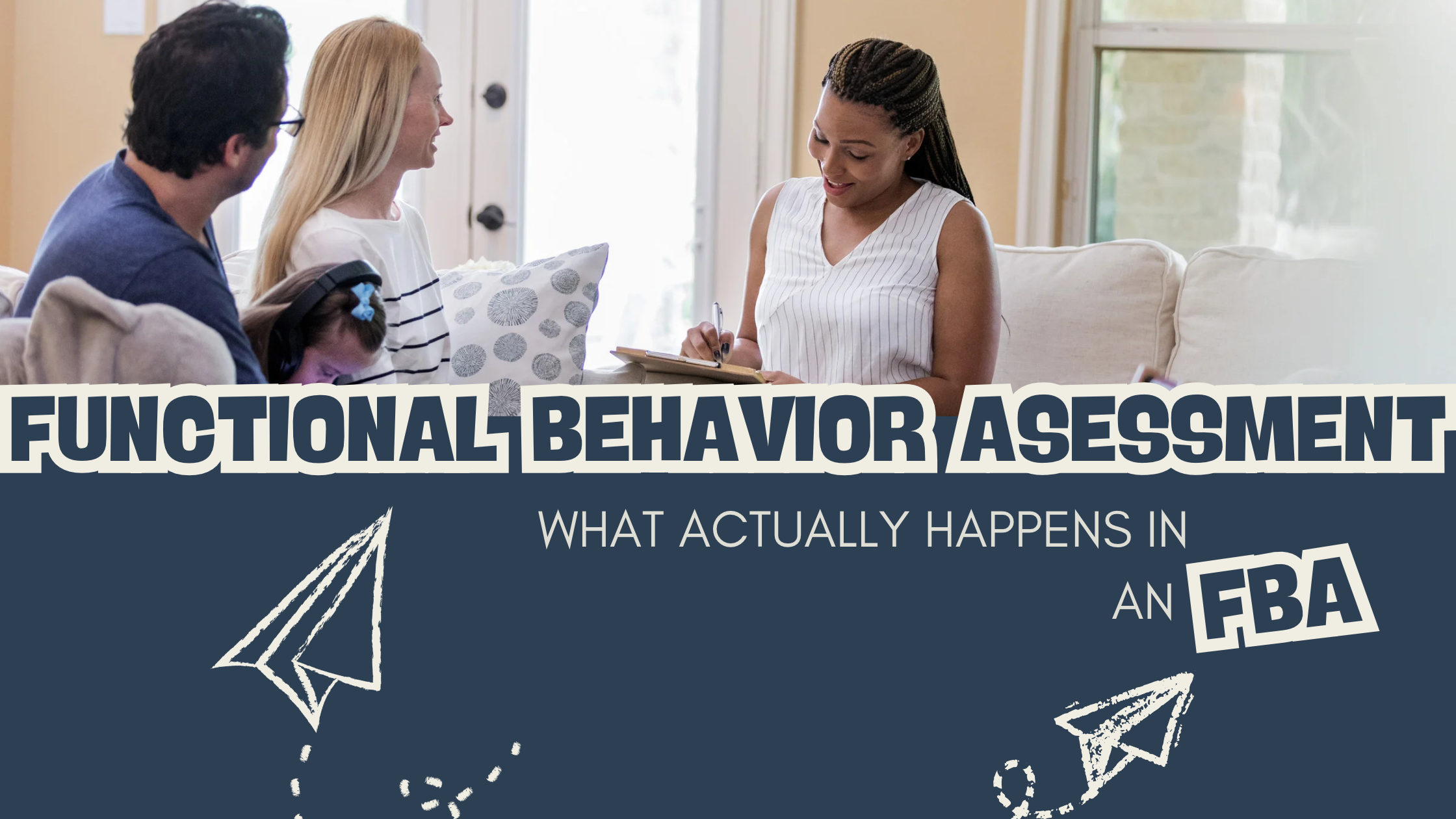
If your child’s school or ABA team has mentioned an FBA, it’s normal to feel a little unsure about what that actually means. The term sounds clinical and a little intimidating — but the process itself is more practical, and more collaborative, than most parents expect.
Here’s what an FBA actually is, what happens during one, and what you should expect to walk away with.
What Is an FBA?
FBA stands for Functional Behavior Assessment. At its core, it’s a structured process for answering one question: what is this behavior actually accomplishing for my child?
Every behavior serves a function — even the ones that look disruptive, frustrating, or hard to understand from the outside. A child might be seeking attention, trying to escape a demand, seeking a sensory experience, or trying to access something they want. An FBA is how we figure out which of these is actually driving a specific behavior, instead of guessing.
That distinction matters enormously. A strategy that works beautifully for an attention-seeking behavior can completely fail — or even make things worse — if the real function is escape. Getting the function right is the foundation everything else is built on.
What Actually Happens During an FBA
1. Record Review
Before any observation happens, we look at what’s already documented — past evaluations, existing behavior data, IEP goals, prior interventions that have been tried. This isn’t just paperwork; it tells us what’s already been ruled out and where the gaps in understanding are.
2. Interviews
We talk to the people who know your child best in the relevant setting — teachers, paraprofessionals, sometimes you as the parent. These conversations often surface patterns that don’t show up in a single observation: “It’s always worse right before lunch,” “It only happens during transitions,” “He’s fine one-on-one but struggles in group work.”
3. Direct Observation
This is the part people picture when they think of an FBA — someone watching the behavior happen in its natural setting. But it’s not passive watching. We’re tracking specific, operationally defined behaviors (more on that below) and noting what happens right before the behavior (the antecedent) and right after (the consequence). That before-and-after pattern is often where the real answer lives.
4. Data Analysis
All of that — records, interviews, observation data — gets pulled together to identify the behavior’s likely function. This isn’t a hunch; it’s a conclusion built from multiple sources pointing in the same direction.
A Quick Note on “Operational Definitions”
You may hear this term and wonder what it means. An operational definition is simply a clear, specific, observable description of the behavior being assessed — written so that any two people watching would agree on whether it happened.
“He gets upset” isn’t an operational definition. “Child drops to the floor, cries, and refuses redirection for more than 30 seconds” is. This precision matters because vague descriptions lead to vague data, and vague data leads to a plan that doesn’t actually target the right thing.
What You Get at the End
An FBA isn’t just an assessment for its own sake — it’s the foundation for a Behavior Intervention Plan (BIP), which outlines specific strategies based on what the FBA revealed. If the function of a behavior is escape from a difficult task, for example, the plan might include teaching a replacement skill — like requesting a break appropriately — rather than simply trying to stop the behavior itself.
This is also where alternative reinforcement often comes in. If a behavior has been maintained by access to something tangible (a toy, a preferred item), part of the plan may involve teaching a more functional way to request or earn that same thing — rather than removing motivation altogether.
What This Means for You as a Parent
- An FBA is not a punishment or a judgment. It’s an information-gathering process aimed at understanding, not blaming.
- You’re part of it. Your observations and input as a parent are a real data source, not a formality.
- The goal is a plan that actually fits. A strategy built on a correctly identified function is far more likely to work — and to work faster — than a generic behavior plan.
- It’s an ongoing process, not a one-time event. Good FBAs get revisited and refined as more data comes in and circumstances change.
If your child’s team has recommended an FBA, it’s a sign that someone is taking the time to understand why before jumping to what to do about it — and that’s exactly how it should work.
Have questions about the FBA or BIP process for your child? Reach out — we’re always happy to walk you through it.